
By Larry Pynn, veteran environmental journalist and publisher of sixmountains.ca
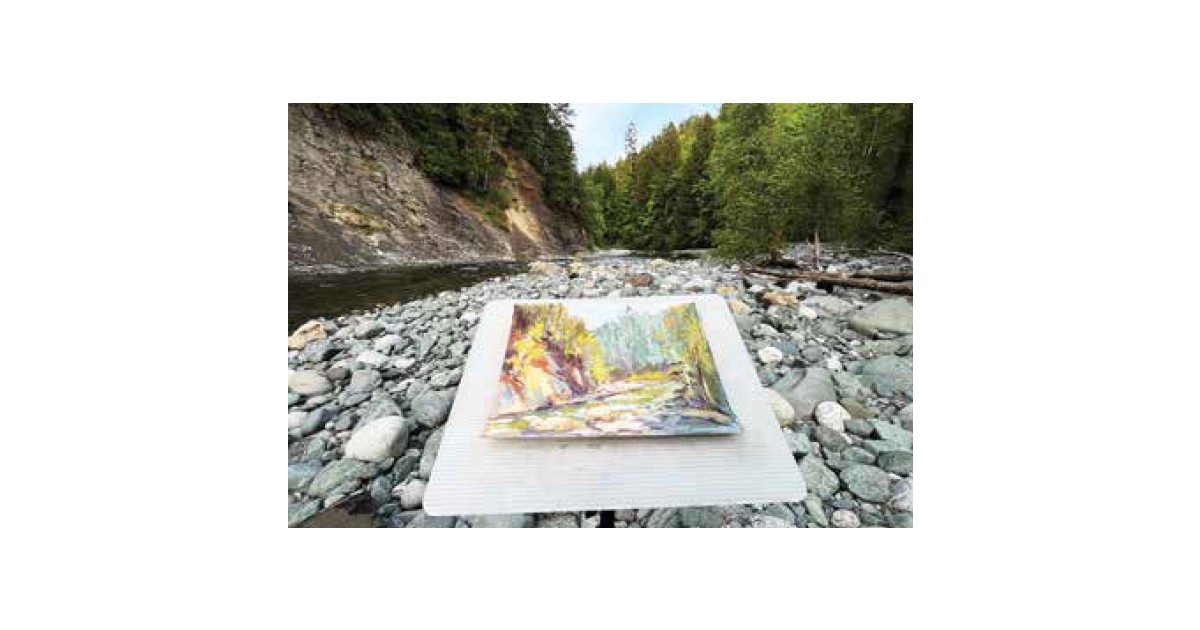
It’s early evening as a group of artists enters a forest of western red cedars, cottonwoods, and bigleaf maples. The setting is the Chemainus River at the northern reaches of the Six Mountains — the popular name for North Cowichan’s 5,000-hectare Municipal Forest Reserve.
The artists are immediately effusive in their praise.
“It’s gorgeous.”
“I’ve found my new home.”
“It’s like entering a church.”
A path winds through swaths of sword fern and vanilla leaf to emerge at a sandy beach where the Chemainus River forms clear pools and gentle rapids. A raven’s call drifts across the landscape. Pebbles tumble down a steep cliff, suggesting a living landscape.
These artists are participating in an en plein air — a reference to artists getting out into nature to stimulate their creativity. The idea is to raise awareness for a forthcoming month-long nature-based art show on the Six Mountains and the endangered coastal Douglas-fir forest.
The mixed-media event, Art of the Six Mountains, runs June 3 to 29 and is a collaboration of the Cowichan Valley Arts Council and sixmountains.ca. The location is 2687 James Street, Duncan, next to the Vancouver Island Regional Library.
Morgan Brayton, the council’s executive director, says the exhibition is meant to celebrate the landscape and encourage a deeper emotional connection through art. “People protect what they love. Artists can help viewers see the Six Mountains not simply as a resource or recreation area, but as a living landscape worthy of care and conservation.”
Why these forests matter
The Six Mountains are Prevost, Sicker, Richards, Maple, Tzouhalem, and Stoney Hill. They are part of the smallest and most endangered forest type in BC, featuring arbutus trees, Garry oak meadows, coastal bluffs, and a Mediterranean-like climate. It contains more species at risk than any other ecological zone in BC.
The Grace Road section near the Chemainus River and Mount Sicker is home to a remnant grove of ancient giants, including the ninth largest cedar on record on the east coast of Vancouver Island.
Logging and urban development are leading threats to the coastal Douglas-fir forest, which is found only on southeastern Vancouver Island, the Gulf Islands, and patches of the coastal Lower Mainland.
A highlight of the exhibition
A talk by Andy MacKinnon, entitled “Rare Ground: Inside BC’s Most Endangered Forest”, takes place on June 10 at 7pm. MacKinnon served as forest research ecologist with the provincial government for three decades and has co-authored six best-selling books on plants of western North America. Admission is by donation.
The political backdrop
A grass-roots movement to save the Six Mountains started in the fall of 2018. In 2023, results of a $300,000 public consultation process showed 76-percent online support for conservation management options, and a statistically valid random phone survey of North Cowichan residents showed 67-percent support for the same two conservation options.
In August 2025, council voted 4–3 to make logging a strategic priority in the forest reserve. Three months later, a reversal: Halalt Chief James Thomas appeared before council to express concerns about renewed logging while closed talks with local First Nations continue. Council agreed to maintain the logging moratorium pending completion of a forest co-management agreement with Quw’utsun Nation.
In the meantime, the Art of Six Mountains exhibition invites the public to step back from the politics and view this fragile landscape through an artistic lens.
Opening Reception: Wednesday, June 3, 7–9pm | CVAC Main Gallery, 2687 James St, Duncan | FREE