

Deep, humus-rich, moisture retentive yet well drained, loamy – these soil characteristics are ideal for growing most plants. In our yards, we may have inherited soils that are clayey, wet, sandy or may even just be builder’s fill. If your inherited garden bed soil is poor quality, consider completely replacing it with better quality soil. If your garden bed soil is moderately clayey or sandy and you wish to leave it in place, you may have to adapt what you are growing to have success.
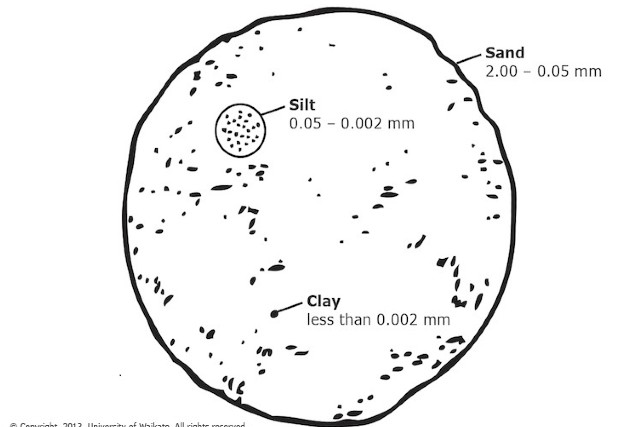
“Right plant, right place”, as we say. In clayey soils, about 40% of the mineral fraction is clay particles, with the remaining 60% a mix of sand and silt particles. For comparison, a loamy soil texture consists of only 20% clay. Clayey soils tend to have poor aeration and drainage, as clay particles bind together to form tight, densely packed aggregates with very little pore space. Consequently, they hold moisture a little too well and compact easily, restricting root growth as well as the free flow of air and water. Clayey soils tend to be fertile as clay particles have a negative charge, enabling them to hold positively charged nutrient cations. Clayey structure can be improved by digging in bulky compost, aged manures and leaves.
Consider planting species that thrive in or at least tolerate clayey conditions, such as hornbeams, apples, willows, Viburnums, Weigela, Echinacea, Bergenia, daylilies, red osier dogwood and witch-hazel. In sandy soils, at least 70% of the mineral fraction consists of sand particles. These particles are large in size, therefore water infiltrates
easily but drains too quickly.
Sandy soils have low nutrient holding capacity, as sand particles are inert and unable to bind nutrient cations. Adding organic matter (OM) to sandy soils will help with moisture retention and aggregate formation as OM
has smaller particle sizes than sand. Adding OM will also improve nutrient retention as the OM particles have
a negative charge. When planting in your sandy garden soil, consider plants that are drought tolerant and have low nutrient requirements, like pine species, mountain ash, rock roses, California lilac, yarrows, gaura and rudbeckia.
An easy exercise to do at home to test your soil drainage is to dig a 1ft sq hole, fill with water, and see how quickly it drains away. If it drains in less than one hour, your soil is fast draining, likely with a high proportion
of sand. If your soil takes over 24 hours to drain, it likely has a high proportion of clay, and/ or may be compacted.
Tamara Dinter, Dinter Nursery General Manager and Soil Enthusiast
EVERY DAY IS EARTH DAY!