

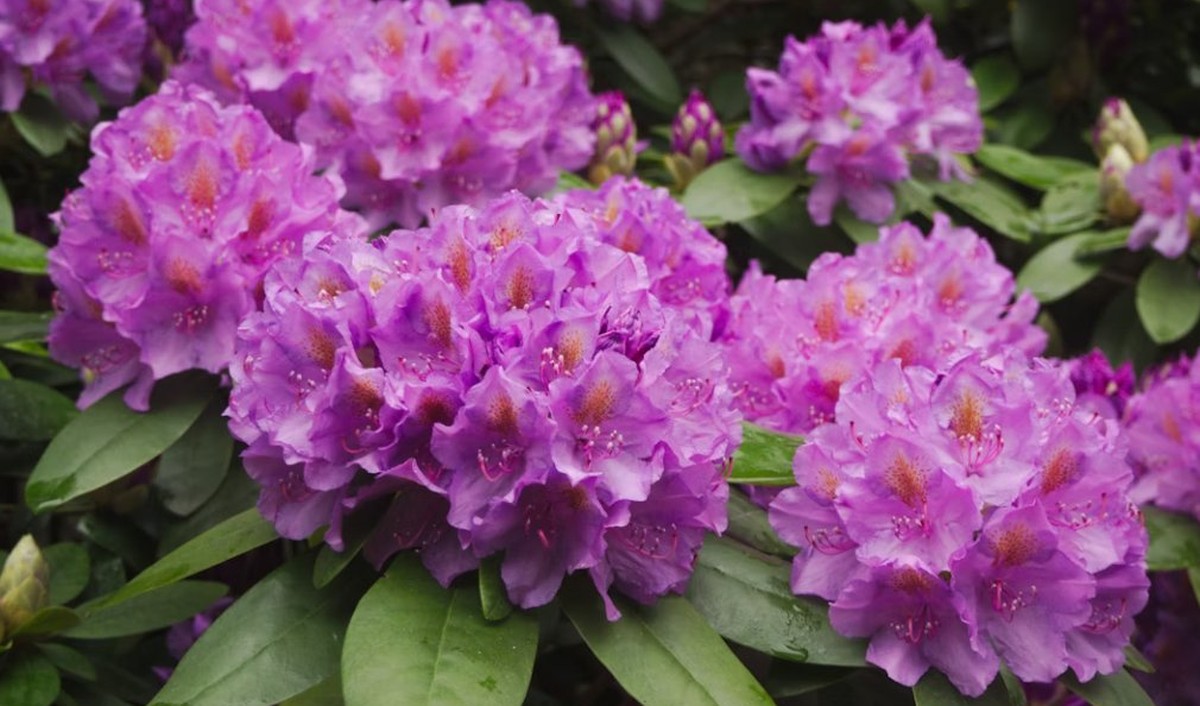
The ubiquitous rhododendron is found everywhere nowadays — part of the foundation planting in front of a house, planted in beds in the local park, or popping up as roadside plantings in a new subdivision. But the rhododendron is relatively new as a garden plant in the western world, and achieved its heyday in the Thirties, mostly as a result of intensive plant hunting in China and the Himalaya.
The Plant Hunters Who Started It All
Names such as Ernest Wilson (known as “Chinese Wilson”), Frank Kingdon Ward, and George Forrest were among the greatest contributors to the popularization of rhododendrons in the western world. Travelling under very harsh and often dangerous conditions, they collected herbarium specimens and seed, which were sent back to England to be germinated and grown on. Rafting down swollen rivers in flood, inching across precarious bridges of bamboo and hemp rope, and often hiding from hostile locals, they risked life and limb to collect new plants and send them back to Europe.
Although the rhododendron was familiar in Europe from a subalpine rhodo in the Alps and Rh. ponticum in the 1700s, the large-flowered and exotic-looking plants of the mysterious east were unknown at the time, and created a sensation when those early plants eventually flowered. With the appearance of the more exotic Chinese and Himalayan introductions, “Rhodomania” took a firm hold on the gardening elite in the twenties and thirties.
George Forrest sent back so much seed that the early subscribers to his expeditions ended up with many more plants than they had planned on — perhaps leading to the first “woodland” gardens, as landowners began planting excess rhododendrons beyond the cultivated garden and into the woodland beyond.
Vancouver Island’s Role in the Rhododendron World
Vancouver Island became a major player in the rhododendron world with the development of Greig’s Royston Nursery in the 1920s and 30s. Their small nursery on the edge of the western world was well known in Europe and Britain as an important source of species and hybrids. Royston hybrids grown today include Harry Carter and Buchanan Simpson.
Notable Species to Know
The first rhodos from the far east were species, not the hybrids we are accustomed to today. They are no less magnificent, although their colours may be purer and simpler. Among them were some of the large-leafed species:
Rh. sino grande — leaves up to three feet long. Rh. arboreum, the tree rhododendron, has flowers whose colour varies by altitude: red at lower elevations, pink at mid elevations, and white at the top of their range. If a rhodo that can grow to 40 feet is a little large for you, the arboreum hybrid ‘Sir Charles Lemon’ is an attractive plant to about 6 feet with strong, handsome foliage.
Rh. williamsianum is one of my favourites — a compact rhodo with distinctive rounded leaves and delicate pink flowers. It forms a shrub of 5′ x 5′, useful for a smaller garden. Just as the flowers fade, the new growth comes in a strong reddish colour, extending its season beautifully.
Rh. bureavii, from the open pine forests of northern Yunnan in China, has glossy green oblong leaves with a thick rusty indumentum (the woolly or hairy covering on the underside of leaves or stem) and white flowers with crimson marks. It has been a prolific parent in many crosses, with readily available offspring such as Gretzel and Hansel.
Dwarf Rhododendrons for Smaller Gardens
There are also some very attractive and hardy dwarf species that prefer to grow in the open and will not grow up to block your windows or sight lines. These range in size from 6 inches up to 4 feet, with smaller aromatic leaves and small clusters of flowers that resemble an azalea more than their taller cousins. They come in a dazzling array of colours — from intense purple to blood red, shocking pink to pure white and yellow.
Look for Rh. impeditum, blooming a good purple in April and topping out at about one foot. Rose Elf is a charming pink to about two feet. Rh. cephalanthemum is almost unrecognizable as a rhodo, looking like a bonsai with smooth tan stems and miniature whitish-pink flowers.
Where to See Rhododendrons at Their Best
Although you can have rhodos blooming from January to August, May is the prime month for seeing rhododendron gardens such as Milner Gardens in Qualicum Beach, or Finnerty Gardens at the University of Victoria.
For more information on varieties that will do well in the Cowichan Valley, talk to your local nursery or the Cowichan Valley Rhododendron Society.
Visit us at the Cowichan Valley Garden Fair on Saturday April 28th at the Cowichan Exhibition Grounds, where local and visiting nurseries and garden-related vendors will have their plants and wares on display. Come early for the best selection!
— Barrie Agar is Head Gardener at Hatley Park National Historic Site / Royal Roads University, and President of the Cowichan Valley Rhododendron Society.