

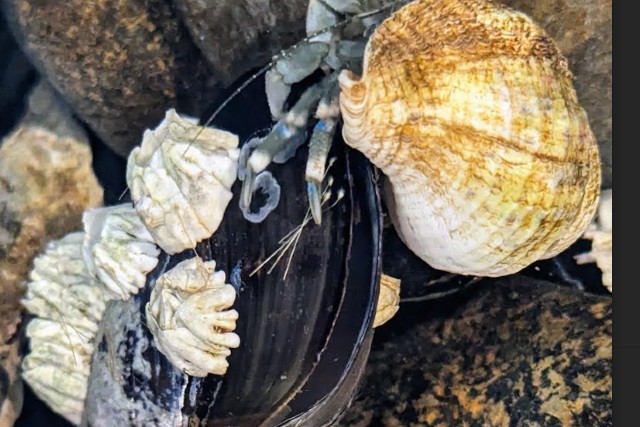
Muscles? Or Mussels? Which one is edible? I guess technically they both are if you’re a
cannibal. The Mussels I’m talking about are of the delicious water based variety.
Living up to their name, mussels are very strong and can survive life in the wild intertidal
zones all over our planet.
What makes a mussel strong? First, mussels are bivalves, which means they have two
shells. Their strong shells are held closed by a muscle called the adductor muscle. The other
thing that makes them strong is their byssal threads, a sort of underwater glue that the
mussel excretes and uses as anchors to avoid being swept away by waves or currents.
Most marine mussels are found in areas where there is decent water flow and tidal
exchange. These intertidal organisms feed on tiny microscopic plants and animals that live in
the water column, called plankton. Mussels feed on plankton by sucking water in through
one siphon, filtering out food particles and then expelling waste and water through the other
siphon.
What eats a mussel? Lots of creatures like mussels. Sea stars and snails are particularly
fond of mussel soup. Gulls like to grab mussels and smash them open so they’re easier to
eat. You can usually see this action on just about any rocky shoreline.
Humans also eat mussels, but unlike sea stars, snails and gulls, we humans have to be very
careful about where and when we harvest them, as well as how we transport and prepare
them for eating.
Because mussels (and other bivalves) eat plankton, they can be poisonous to humans. This
poison comes from a type of naturally occurring marine biotoxin that is found in some types
of microscopic organisms. The occurrence of a bloom of marine biotoxin is commonly known
as “red tide”, and the resulting poisoning is called Paralytic Shellfish Poisoning (PSP). PSP
can be as mild as tingling and numbness in the mouth to complete paralysis and death in a
very few minutes. It’s always best for humans to purchase bivalves from a reputable seafood
store or restaurant.
If you do decide to harvest your own bivalves, please research where and when to harvest
them safely, being poisoned and potentially dying is not worth the risk. The Department of
Fisheries and Oceans has all the information you need on their website.
As always, please don’t harvest any more than you can eat.
Madeline Southern
Education Coordinator
Cowichan Estuary Nature Centre
Cowichanestuary.ca