

Niki is the co-owner/ operator of Tatlo Road Farm, an organic vegetable farm in Crofton.
Growing garlic is simple and wonderfully satisfying, not to mention it’s one of the easiest crops for which to save your own “seed”. Technically when you plant garlic, you’re planting individual cloves (not seed), and each clove is a clone of the parent bulb. For this reason, nearly all types of garlic can be traced back to just a handful of varieties, which fall into one of two subspecies: hard-neck and soft-neck.
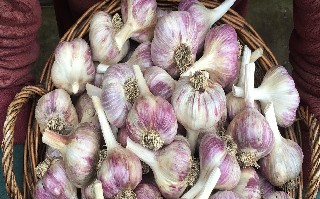 Growing technique for hard and soft neck garlic is the same. The main differences are that in late spring hard-neck garlic will produce “scapes”, which are delicious to snap off and eat, while soft neck does not. However, if you’re wanting to make beautiful garlic braids with your harvest, I would recommend soft-neck for this purpose (it also tends to be ready for harvest slightly earlier than most hard-neck types and potentially stores for longer).
If you are just starting out, ask yourself how much do you want to grow? Think in of how many bulbs you’d like to have for the winter, plus how much you’ll need to plant your crop for next season. Garlic is planted in the fall, and in our region really that means any time between September and even as late as February, so long as conditions permit (e.g. the soil isn’t too wet, frozen, or covered with snow!).
When planting, use individual cloves spaced 6” apart, in rows that are 12” apart. For example, if I want to have 50 heads of garlic for the year (enough for ~1 head/ week), then I would need to plant 50 cloves. And don’t forget to factor in extra for replanting your crop in the fall (so that you don’t have to buy new “seed” garlic each year).
The number of cloves per head can vary a lot depending on the variety. On our farm we grow Red Russian, which is known for its large heads and cloves, but it only has 5 cloves per head on average (other varieties often have more). If I’m planting Red Russian and I want 50 cloves for replanting, then I would estimate saving about 10 heads for this purpose. So in total I would grow 60 heads (i.e. plant 60 cloves) at the outset, in order to produce 50 heads for eating plus 10 heads for replanting.
In addition to the row spacing mentioned above, some other considerations for growing garlic are nutrients and water. Garlic is not a huge feeder, but will appreciate the addition of some compost and/ or organic bone or fishmeal at the time of planting. It’s important to plant the garlic in well-drained soil or a raised bed, so that it’s not too saturated over winter, which can cause it to rot. Last, you may want to mulch it with an insulative layer of straw for the winter to protect it from the freeze-thaw cycles that can occur in our region. The mulch may also help suppress weeds in the spring. Either way, you will want to control weeds around your garlic, as it does not size up as well with a lot of weed pressure.
Garlic doesn’t usually need much irrigation, but if we do have a hot dry spring you may want to water it a few times in May and June. Make sure to stop watering a couple weeks before harvest to help the leaves dry down. Typically, we harvest our Red Russian garlic in mid-July, when we see that about 5 leaves are dry and brown.
After harvest, cure your garlic in a warm, dry place for a couple weeks. After that, garlic stores best in a dry, cool (1-10 degrees C), and well-ventilated space.
Last, a note about buying seed garlic. Do not just plant random garlic that was purchased at the grocery store! This can introduce various diseases (the worst being White Rot) that can make it impossible to grow garlic in the future. Instead purchase it from a seed company or garden centre that sells certified seed, or a local farmer that can confirm the absence of garlic disease on their farm.
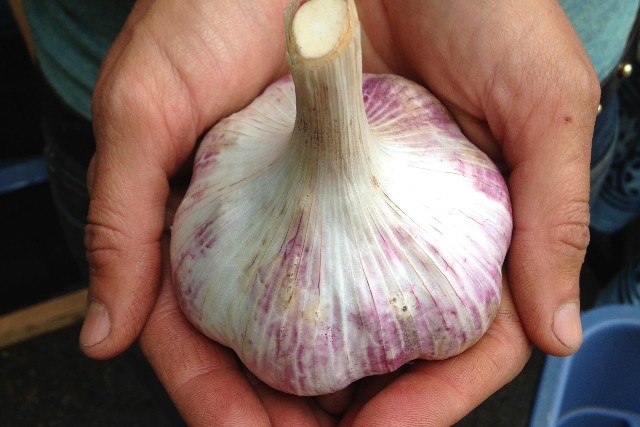
We’ve been growing garlic on our farm for 10 years now. While we started with a few different varieties, purchased from farmers in the Interior, we gradually narrowed them down to just Red Russian. We love its size, flavour, large cloves, and beautiful purple-tinged colour. This variety was originally brought Canada over 100 years ago by the Dukhobors from Southern Russia and Ukraine. It thrived particularly well in the cool damp climate of Southwest BC and has now become a BC heritage variety.
Our farm is known for growing beautiful, large garlic, but I honestly don’t feel like we can take that much credit. Really the best first step you can take when growing garlic is starting with good “seed”. That is what we did, and now we are happy to sell our garlic on to others who want to grow their own (or anyone who simply wants to eat it!).
Niki Strutynski
Niki is the co-owner/ operator of Tatlo Road Farm, an organic vegetable farm in Crofton.